

|
|
| নির্বাচিত পোস্ট | লগইন | রেজিস্ট্রেশন করুন | রিফ্রেস |
In 1920 a huge discovery in South Asia proved that Egypt and Mesopotamia were not only early civilization.In the vast Indus river plants,under layers of lands and mounds of dirt archaeologists discovered the remains of a 4600 year old city.The civilization was in 3300-1300 BCE.Indus valley was a developed civilization. Harappan,Mohenjo daro Their Cities were well planned .They had wide streets,public and private wells,Drains,Bathing platforms.They used same sized ricks for walls.These expertly constructed cities were parts of an advanced civilization compared to Egypt and Mesopotamia.The houses of these cities had as many as three floors and well constructed bathroom that were connected to sewers.their drainage system were century ahead than their time. The advanced architecture of the Harappans is shown by their impressive dockyards, granaries, warehouses, brick platforms, and protective walls. The massive walls of Indus cities most likely protected the Harappans from floods and may have dissuaded military conflicts.In sharp contrast to this civilisation's contemporaries, Mesopotamia and ancient Egypt, no large monumental structures were built. There is no conclusive evidence of palaces or temples or of kings, armies, or priests. Some structures are thought to have been granaries. Found at one city is an enormous well-built bath (the "Great Bath"), which may have been a public bath. Although the citadels were walled, it is far from clear that these structures were defensive. They may have been built to divert flood waters.The people of the Indus Civilisation achieved great accuracy in measuring length, mass, and time. They were among the first to develop a system of uniform weights and measures. A comparison of available objects indicates large scale variation across the Indus territories.The Indus civilization's economy appears to have depended significantly on trade, which was facilitated by major advances in transport technology. They may have been the first civilization to use wheeled transport.These advances may have included bullock carts that are identical to those seen throughout South Asia today, as well as boats. Most of these boats were probably small, flat-bottomed craft, perhaps driven by sail, similar to those one can see on the Indus River today; however, there is secondary evidence of sea-going craft. Archaeologists have discovered a massive, dredged canal and what they regard as a docking facility at the coastal city of Lothal in western India . An extensive canal network, used for irrigation, has however also been discovered by H.-P. Francfort.
Source: Wikipedia,My assignment on History of art and design. 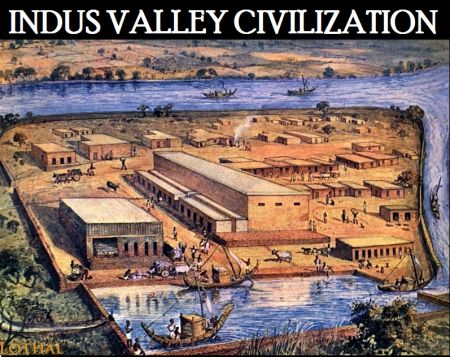
 ০ টি
০ টি  +০/-০
+০/-০©somewhere in net ltd.
